- 3434 SW 53rd Ct, Fort Lauderdale, FL 33312, United States
- [email protected]
- 3434 SW 53rd Ct, Fort Lauderdale, FL 33312, United States
- [email protected]

- About
- Services
- Emergency Plumbing in Fort Lauderdale, FL
- Residential Plumbing in Fort Lauderdale, FL
- Commercial Plumbing Services in Fort Lauderdale, FL
- Top-Rated Drain Cleaning Services in Fort Lauderdale, FL
- Leak Detection in Fort Lauderdale, FL
- Pipe Repair in Fort Lauderdale, FL
- Water Filtration in Fort Lauderdale, FL
- Hydro Jetting
- Tub and Shower Fixtures Fort Lauderdale, FL
- Sewer Line Repair Fort Lauderdale, FL
- Sewer Inspection Fort Lauderdale, FL
- Repiping
- Backflow Prevention in Fort Lauderdale, FL
- Top-Rated Water Heater Repair Services in Fort Lauderdale, FL
- Faucet Repair in Fort Lauderdale, FL
- Toilet Repair in Fort Lauderdale, FL
- Plumber in Boca Raton
- Plumber Miramar FL
- Backflow Prevention in Miramar, FL
- Commercial Plumbing
- Residential Plumber Miramar FL
- Drain Cleaning
- Emergency Plumber
- Faucet Repair
- Garbage Disposal Repair
- Hydro Jetting in Miramar, FL
- Leak Detection
- Repiping Miramar FL
- Sewer Line Repair in Miramar, FL
- Sewer Inspection Miramar FL
- Toilet Repair Miramar FL
- Tub and Shower Fixtures Miramar FL
- Water Filtration in Miramar, FL
- Pipe Repair Miramar FL
- Service Areas
- Fort Lauderdale Neighborhood
- Serving All of Fort Lauderdale, FL
- Plumber Alandco FL
- Plumber Broadview Park FL
- Plumber Flagler Village FL
- Plumber Hacienda Village FL
- Plumber Harbor Beach FL
- Plumber Las Olas Isles FL
- Plumber Melrose Manors FL
- Plumber Progresso Village FL
- Plumber Rio Vista FL
- Plumber Royal Poinciana FL
- Plumber Tarpon River FL
- Plumber Victoria Park FL
- Plumber Melrose Manors FL
- Miramar Neighborhoods
- Our Locations
- Plumber Oakland Park FL
- Plumber Plantation FL
- Plumber Pompano Beach
- Plumber Sunrise FL
- Plumber Tamarac FL
- Plumber Weston FL
- Hollywood FL Plumber
- Plumber Coconut Creek FL
- Plumber Cooper City FL
- Plumber Coral Springs FL
- Plumber Davie FL
- Plumber Deerfield Beach
- Plumber Lauderhill FL
- Plumber Dania Beach FL
- Plumber Hallandale Beach
- Plumber Margate FL
- Plumber Pembroke Pines FL
- Plumber Parkland FL
- Contact
An Honest Plumber’s Guide
Tips for choosing The Best Water Heater Solution in 2026
An Honest Plumber’s Guide
Ask five different homeowners which water heater brand is best and you’ll likely get five different answers, most of them based on whichever brand happened to be installed in their last home. The truth is less tidy than a single winner, but it’s not a mystery either.
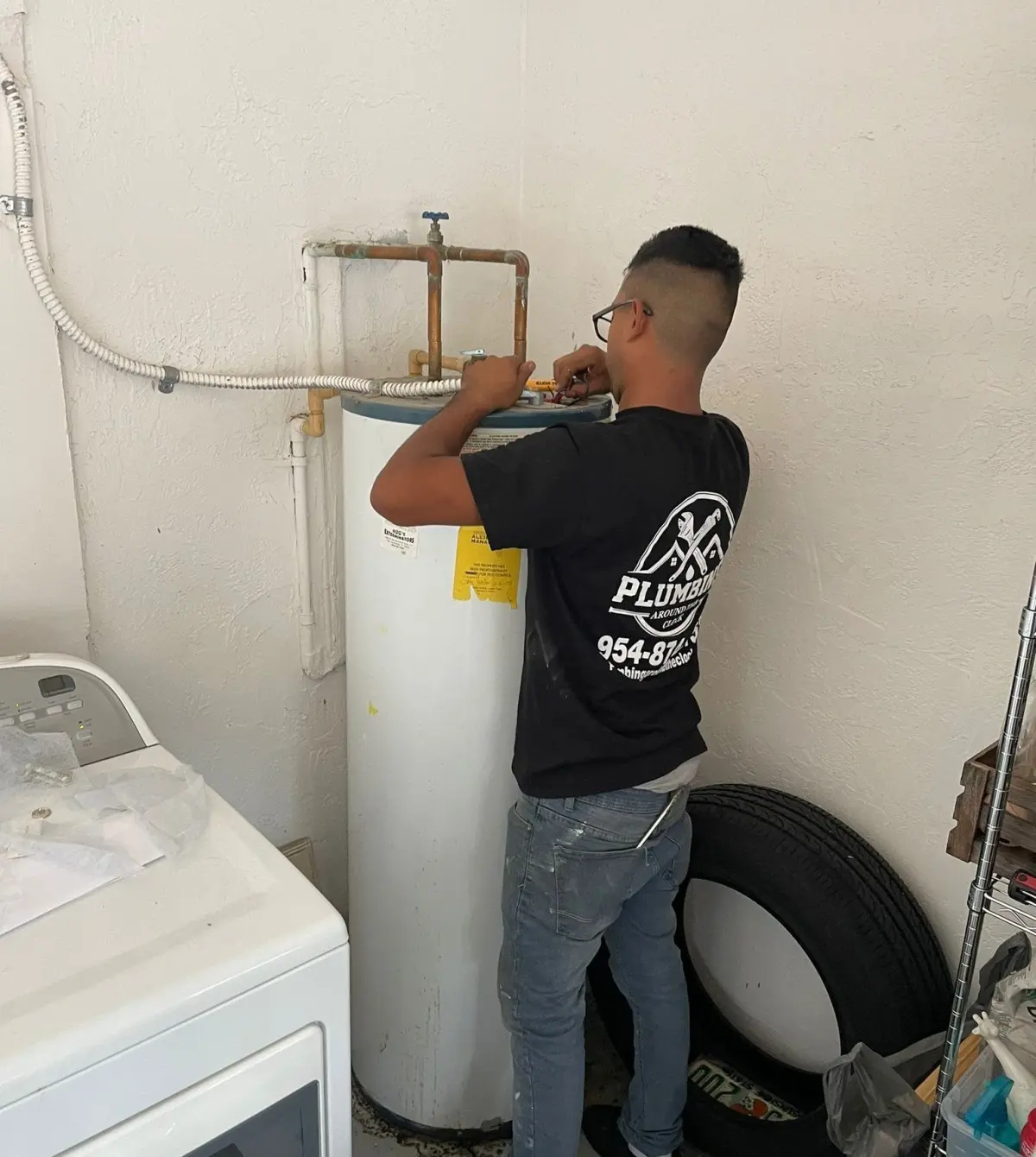
Some brands consistently hold up better than others, some warranty tiers are worth paying for and some aren’t, and installation quality matters as much as anything printed on the nameplate.
Here’s an honest, application-based breakdown of where the major water heater brands actually stand in 2026. You can also check out our complete guide on traditional water heaters VS tankless water heaters.
01
Quick Answer On Water Heater Brands
There isn’t one universal “best” electric water heaters brand, and any source that tells you otherwise is oversimplifying. The right choice depends on your budget, your household’s hot water demand, your water quality, and whether you value lowest upfront cost or lowest cost of ownership over 15 to 20 years. That said, a few patterns hold up consistently: Bradford White and A.O. Smith’s premium lines lead on tank longevity, Rheem offers the strongest balance of features and availability, and Rinnai and Navien are the two names worth taking seriously for tankless.
02
Most Dependable Residential Water Heater Brands.
A handful of brands show up again and again in plumber recommendations, for good reason. Each earns its reputation differently:
BW
Bradford White
Sold exclusively through licensed plumbers from the plumbing supply house, never at big box retailers, which keeps their build quality consistent since there’s no budget consumer line pulling the brand downward. Great option if your plumber offers it!
AO
A.O. Smith
One of the two largest manufacturers in North America, with strong availability and a genuinely excellent warranty on their premium ProLine XE tier
RH
Rheem
A strong all-around performer with wide parts availability and dependable customer support, a common default pick for both storage tank water heaters and tankless installs, Rheem water heaters deliver great performance for decent pricing.
RN
Rinnai
The longest-established name in tankless, with a massive installer base and a conservative, proven engineering approach
NV
Navien
Sewer to the US market than Rinnai but has built a strong reputation on efficiency and technology in the years since
03
Best Traditional Electric Water Heater Tank Brands
For a standard tank installation, three names dominate the recommendations from working plumbers: Bradford White, A.O. Smith, and Rheem, and storage tank water heaters typically hold 30 to 80 gallons.
Bradford White’s contractor-only distribution model means every unit, not just the premium tier, is built to the same standard, with glass lined tanks and a coating designed to resist hard-water scale; routine maintenance still matters, and flushing the tank annually helps reduce mineral build-up and extend service life. A.O. Smith splits more clearly by tier: their 6-year warranty models are commodity-grade, while the 12-year ProLine XE units use thicker glass lining and a better anode rod that genuinely extends service life, though it should be checked periodically in hard-water conditions. Rheem sits in between on positioning, with strong build quality and some of the best parts availability in the industry, which matters when a water heater repair is needed years down the line.
04
Best Tankless Water Heater Brands
Rinnai and Navien are the two brands worth serious consideration for a tankless install, since these tankless units are on-demand systems that deliver a constant supply of hot water.
Navien is especially competitive because some models reach up to 0.96 uniform energy factor efficiency, and on residential lines the warranty terms can include 15-year coverage on heat exchangers. Noritz is also respected, particularly for its heat exchanger warranty, though it has a smaller installer footprint in most of Florida than the other two. Rheem also makes a tankless line and is a reasonable option if you want one brand across your whole plumbing system, and these models can work well in small spaces when properly sized, though it’s generally considered a step behind Rinnai and Navien specifically for tankless performance.

05
Best Natural Gas Water Heater Brands
For traditional natural gas tank water heaters, Bradford White, A.O. Smith, and Rheem are among the best brands to compare in 2026. Bradford White is a strong contractor-grade choice because its products are distributed through plumbing professionals, and its gas models feature glass-lined tanks, intelligent gas controls, and model-dependent six- or 10-year warranties.
A.O. Smith offers everything from standard atmospheric-vent tanks to high-efficiency premium systems, while Rheem provides a similarly broad selection with warranty tiers extending up to 12 years on certain residential gas models. Compare the specific model—not only the logo—by looking at its Uniform Energy Factor, first-hour rating, venting requirements, warranty coverage, and local service support. Current ENERGY STAR efficiency thresholds begin at 0.81 UEF for gas storage heaters under 55 gallons and 0.86 UEF for units of 55 gallons or more.
For natural gas tankless water heaters, Rinnai and Navien remain leading specialist brands, with Rheem and A.O. Smith also offering competitive condensing models. Rinnai’s current SENSEI RX line reaches up to 0.98 UEF, while Navien’s NPE-2 series reaches up to 0.96 UEF and includes a 15-year residential heat-exchanger warranty under qualifying installation and recirculation conditions. Rheem and A.O. Smith also sell ENERGY STAR-certified natural gas tankless models around 0.95 to 0.96 UEF with 15-year heat-exchanger coverage. The best natural gas water heater brand is ultimately the one that can be correctly sized for the household’s peak hot-water demand and supported by a qualified local installer, since gas-line capacity, venting, condensate drainage, recirculation design, and water quality can all affect performance and reliability.
06
Best Budget-Friendly Brands: New water heaters
If upfront cost is the priority, entry-level Rheem and A.O. Smith models available through big box retailers offer the most accessible price point while still coming from established manufacturers.
These aren’t the units a plumber will describe as built for 15-plus years of service, but for a rental property, a starter home, or a homeowner who needs hot water restored on a tight budget, they’re a legitimate, functional choice rather than a compromise to be embarrassed about. EcoSmart is also a notable budget pick for electric tankless water heaters, and some models include limited lifetime warranties.
07
Pro Tip: Pay Attention To Water Heater Energy Efficiency
This isn’t about naming any manufacturer as objectively bad, since most major brands make both strong and weak water heater products depending on the specific line. A few things are worth genuine consideration when deciding on your new water heater brand & product:
The lowest-tier warranty models from any brand, typically 6-year coverage, use thinner tank walls and lower-grade anode rods, and in Florida’s hard water, that shorter warranty period often lines up closely with when problems actually start
Store-branded or private-label units sold under a retailer’s house brand, which are sometimes manufactured by a known brand to a lower spec than their own name-brand product
Any tankless unit installed without proper sizing for the household’s actual peak demand, regardless of brand, since undersizing causes performance complaints that get unfairly blamed on the manufacturer
Units installed without a required expansion tank or without meeting local venting code, which creates problems that show up as “unreliable equipment” but are actually installation issues
If you choose a product line with low energy efficiency, you may have trouble being able to heat water efficiently to keep power costs down. More expensive brands can also come with a complex installation & even higher installation costs, but the energy efficiency will pay off in the long run & life of the unit!
08
Commercial Water Heater Brand Guidance
Commercial storage water heaters remain the practical default where demand comes in large, predictable spikes, such as dishwashing in a restaurant, multiple washers filling in a laundromat, or morning and evening peaks in a multifamily building.
Light-commercial electric tanks commonly run from roughly 6 to 119 gallons with inputs from about 1.5 to 12 kW, while heavier commercial electric models can reach 90 kW for rapid recovery or high-temperature sanitizing applications. Gas storage units generally step up through approximately 50- to 125-gallon tanks, with high-recovery models such as Rheem’s Xtreme rated up to 756 gallons per hour and A.O. Smith’s 120-gallon Cyclone XL rated at 882 gallons per hour at a 100°F temperature rise. Those numbers make A.O. Smith Commercial a strong all-purpose choice for restaurants, multifamily buildings, and engineered replacement work; Bradford White Commercial a dependable plumber-supplied option for gas and convertible electric storage; Rheem Commercial a good fit when fast recovery and readily sourced replacement parts matter; and Lochinvar one of the better choices for high-input, ASME, booster, and more heavily engineered mechanical-room applications.
Commercial tankless systems make the most sense where floor space is limited, demand varies throughout the day, or the owner wants modular redundancy instead of relying on one large tank. Rinnai Commercial has one of the most mature rack-system and application-engineering programs, with commercial heat-exchanger coverage of eight years or 12,000 operating hours on qualifying systems; Navien Commercial is especially competitive for condensing cascades because selected units can be linked in groups of up to 32 and common-vented in groups of up to 12; and Noritz is a credible restaurant and multifamily choice through its NCC199 commercial platform, which delivers up to 11.1 GPM per unit and uses dual stainless-steel heat exchangers. HTP deserves consideration for stainless commercial storage, particularly its Everlast light-duty electric line with a 10-year limited tank warranty, while Bosch is better treated as a point-of-use specialist for remote sinks, break rooms, offices, warehouses, and similar low-volume fixtures. In high-cycle service, the recurring problems are usually scale-restricted heat exchangers, dirty flame sensors or ignitors, blocked condensate traps, neglected inlet filters, recirculation controls that make units short-cycle, depleted anodes, sediment-covered electric elements, and tanks that eventually corrode after maintenance is ignored. Condensing units also require approved venting, a properly trapped and neutralized condensate drain where required, correctly sized gas piping, isolation valves for flushing, and a recirculation design that follows the manufacturer’s warranty conditions.
09
Water Heater Brand Comparison: Rheem vs. A.O. Smith vs. Bradford White
| Rheem | A.O. Smith | Bradford White | |
|---|---|---|---|
| Distribution | Retail and contractor | Retail and contractor | Licensed plumbers only |
| Typical warranty | 6–12 years | 6–12 years | 6–10 years |
| Typical lifespan | 9–12 years | 9–12 years | 11–14 years |
| Best known for | Balance of features and availability | Wide accessibility, strong premium tier | Consistent build quality across the line |
| Parts availability | Excellent | Excellent | Good, through contractors |
None of the three is a wrong choice for a standard residential tank. Warranty coverage commonly runs from 3 to 15 years depending on the model and brand. Rheem and A.O. Smith are easier to source quickly, including same-day, since they’re stocked at retail and supply houses. Bradford White typically requires ordering through a plumber, and contractor-grade water heaters are typically more reliable than retail-grade models, which helps explain why a bradford white water heater has such a strong field reputation and slightly longer average lifespans.
08
Rinnai vs. Navien
Both are excellent tankless brands, and the choice mostly comes down to priorities rather than one being clearly superior, especially since gas tankless water heaters received excellent scores for energy consumption costs and can help deliver lower energy bills than many tank-style options:
01
Rinnai has the longer US track record, a larger installer base, and every model in their lineup has a proven, conservative engineering history
02
Navien is condensing across its entire range, meaning there’s no lower-efficiency tier to accidentally choose; its high efficiency design captures heat from exhaust gases to preheat incoming water, making the lineup more energy efficient, and it offers a longer heat exchanger warranty on most residential models
03
Field data suggests Navien’s failure rate over the first decade runs somewhat higher than Rinnai’s, generally attributed to control board issues, though both remain solid performers within their expected lifespan
04
Rinnai offers more direct-to-homeowner customer support, while Navien’s support model leans more heavily on the installing contractor
09
Why Water Heater Installation Quality Matters
A premium water heater installed incorrectly will underperform a mid-tier unit installed correctly, every time.
Proper sizing, correct venting, code-compliant expansion tanks, and precise gas or electrical connections affect performance and longevity as much as the nameplate on the unit. This is part of why choosing the right water heater installer matters at least as much as choosing the right brand, and it’s worth asking any plumber directly about their installation process rather than assuming brand alone guarantees the outcome.
10
Retail-Grade vs. Contractor-Grade Water Heaters
It's worth understanding that the same brand name doesn't always mean the same product.
Some manufacturers build slightly different specifications for units sold at retail versus units sold through licensed contractors, even under an identical brand name. This isn’t necessarily deceptive, retail units are often designed for easier DIY installation, but it does mean two water heaters with the same brand badge can have meaningfully different components inside. When in doubt, ask your plumber whether the specific model you’re being quoted is their standard contractor-grade unit or a retail-sourced one.
11
Tips To Choose the Right System for Your Household
A few factors should drive the final decision more than brand loyalty alone:
01
Fuel type
Gas units generally recover faster and cost less to operate than electric in most of Florida, though electric avoids the need for gas line access. If you do not have natural gas then you will have to go with an electric water heater.
02
Household size
A larger household with overlapping hot water demand, especially homes with multiple bathrooms, benefits from either a larger tank or a properly sized tankless unit rated for simultaneous use when choosing the best water heater brand for that layout
03
Efficiency
Higher-UEF models cost more upfront but pay that back over time through lower utility bills, especially relevant given Florida’s air conditioning-heavy electric bills; heat pump options are often among the best water heaters for efficiency because many models are two to four times more efficient than conventional units, and energy star certified models can save hundreds on energy bills, making a trusted best brand worth the premium for some buyers
04
Local parts availability
A well-supported brand in your specific area means faster repairs and shorter waits if something does go wrong down the line, while best water heater brands may also offer digital displays and wifi connectivity for app-based monitoring and diagnostics, but those extras should stay secondary to sizing and service support
05
Warranty
A longer warranty is usually, though not always, a genuine signal of better components rather than just a marketing number
Frequently Asked Questions
What's the most reliable water heater brand overall?
Bradford White and A.O. Smith’s premium lines consistently rank highest for tank longevity, while Rheem offers strong reliability with the widest availability. For tankless, Rinnai and Navien are both excellent, with slightly different strengths.
Is it worth paying more for a premium warranty tier?
Generally yes. Longer warranties on tank water heaters typically reflect heavier-gauge steel and better anode rods, not just marketing, and water heater terms commonly run from 3 to 15 years overall. A.O. Smith warranties typically range from 6 to 12 years depending on the line, and warranty coverage can vary by brand, model, and features, so check the product documentation or ask a licensed plumber. Warranty claims are relatively rare before year 8 to 10 regardless of brand, so the extended coverage tends to represent genuinely better components.
Are store-brand water heaters the same as name-brand units?
Not always. Some retailers sell house-branded units manufactured by a known brand to a different specification than that brand’s own labeled product. It’s worth asking directly if you’re comparing a store brand to a name brand.
Does the brand matter more than the installation?
Installation quality has just as much impact on performance and lifespan as the brand itself. Correct sizing, venting, and code compliance matter enormously, regardless of which manufacturer’s name is on the unit.
How do I know which brand is right for my home?
It depends on your budget, household size, and how long you plan to stay in the home. A licensed plumber can walk through your household’s actual usage and recommend a brand and tier that matches, rather than defaulting to whichever unit is easiest to source.